
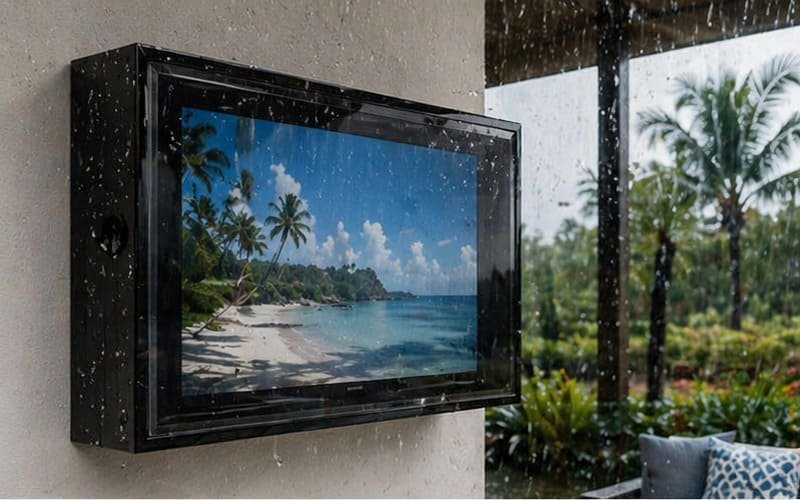
Your outdoor TV is a big investment. But in humid, salty air, rust, moisture, and poor airflow can slowly damage both the TV and the enclosure around it. For a bar, resort, poolside venue, or coastal restaurant, that can mean costly replacements and unhappy customers during your busiest season.
For humid and coastal environments, a polycarbonate TV enclosure is often the lower-risk choice because the enclosure body itself does not rust like steel. Metal enclosures, especially powder-coated steel, can become vulnerable at scratches, cut edges, screw holes, welded seams, locks, and gasket areas. Once corrosion starts near the seal, it may affect long-term weather protection.
I talk to business owners and installers about this problem all the time. Many of them believe that a heavy metal box must be stronger and better. It’s a natural assumption. Metal feels solid, premium, and familiar.
But when we’re talking about protecting electronics near the ocean, a pool, or in a humid climate like Florida, “stronger” isn’t just about resisting impact. It’s also about resisting the constant, silent attack of moisture, salt air, heat, and maintenance neglect.
The real question isn’t only what the enclosure is made of. The real question is how the entire system performs over years of exposure: body material, coating, gasket channel, locks, hinges, cable exits, airflow, and installation quality.
Let’s look at the real-world risks you need to consider.
Last Updated: April 27, 2026 | Estimated Reading Time: 7 minutes
By Smith Chen, Outdoor TV Enclosure Engineer at Outvion
You want the best protection and assume heavy metal is the answer. But in a humid or coastal location, a single scratch, cut edge, screw hole, or seam can become a weak point over time.
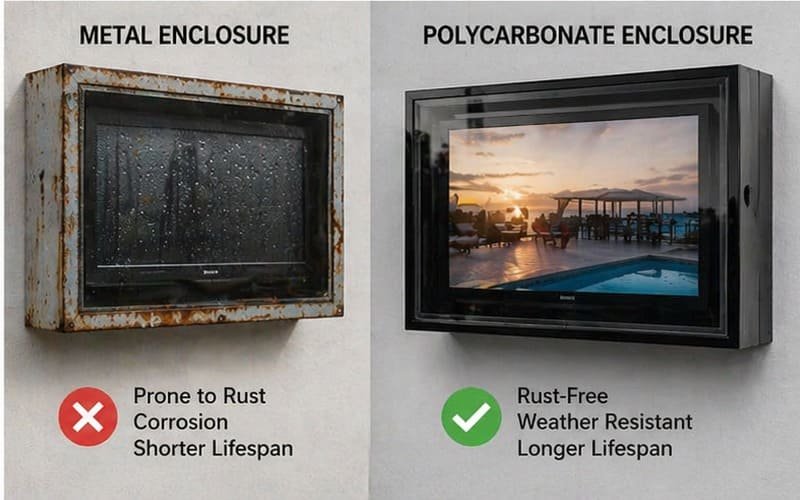
While metal feels solid and premium, its long-term weakness in humid or coastal environments is often corrosion at damaged or exposed points. Powder coating can protect the surface, but scratches, screw holes, cut edges, seams, locks, and hinges may still become vulnerable. A polycarbonate body does not rust like metal, which can make it a lower-risk choice for coastal, poolside, or high-humidity locations.
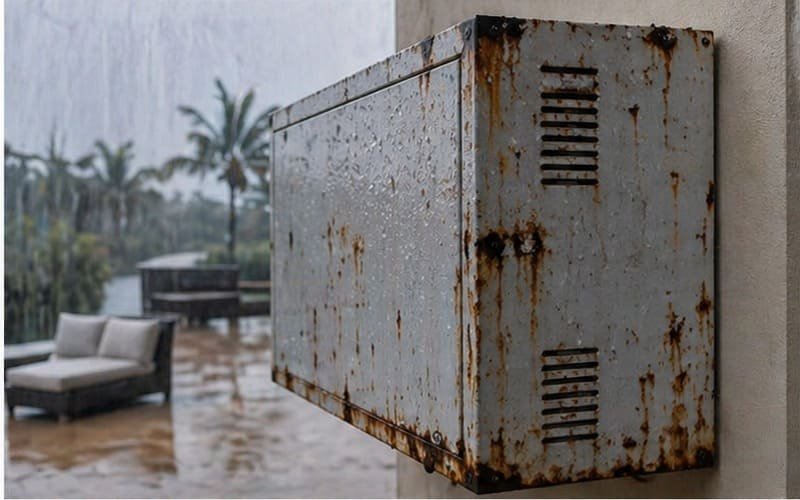
From a manufacturer’s perspective, we see this issue frequently. A buyer invests in a powder-coated steel or aluminum enclosure, and it looks fantastic on day one. It feels solid and secure. The problem often starts months or years later.
Maybe a tool scraped the surface during TV installation. Maybe a screw hole was drilled or adjusted on site. Maybe a chair, ladder, or cleaning tool bumped against the enclosure. That tiny break in the coating may not look serious at first, but in salty or humid air, it can become a starting point for corrosion.
This is especially important near the ocean. Marine-grade powder coating resources often point out that coastal atmospheres contain chloride ions, and coating defects such as scratches, chips, and cut edges can become starting points for filiform corrosion. Marine-grade powder coating and coastal corrosion
Once rust or coating failure begins near a gasket, lock, hinge, or mounting point, you are not only dealing with an aesthetic problem. Corrosion can create uneven surfaces. Uneven surfaces can affect gasket compression. And if the seal is no longer tight, moisture has a better chance to reach the TV.
Polycarbonate does not have this exact weakness. A scratch on a polycarbonate case is still a scratch, and it may affect appearance, but it does not become a rust point in the way exposed steel can. This is one reason I see polycarbonate as a lower-risk material for long-term total cost of ownership in harsh environments.
To be fair, metal is not always a bad choice. A well-designed aluminum or stainless steel enclosure with marine-grade coating, stainless hardware, and regular maintenance can perform well in many outdoor environments. The problem is that in humid coastal locations, the failure points are often not the large flat panels. They are the scratches, drilled holes, seams, hinges, locks, and gasket contact areas. That is where I see polycarbonate as a lower-maintenance option for many B2B buyers.
| Feature | Metal Enclosure | Polycarbonate Enclosure |
|---|---|---|
| Initial Feel | Solid, premium, heavy | Lighter, modern, sometimes seen as “plastic” |
| Corrosion Risk | Depends on metal type and coating; scratches, seams, and screw holes are weak points | Body does not rust like metal |
| Maintenance | Scratches and coating damage may need touch-up | Simple cleaning; no rust treatment on the body |
| Long-Term Seal | Risk increases if corrosion forms near gaskets or locks | Seal is not threatened by body rust, but gaskets and hardware still matter |
| Coastal Use | Needs careful coating, hardware, and inspection | Lower body-corrosion risk in salt-air environments |
| Weight | Usually heavier | Usually lighter and easier to handle |
One detail I always remind customers about: polycarbonate should not be confused with ordinary thin plastic. High-quality polycarbonate is used because it can combine impact resistance, transparency, and lighter weight. Covestro describes Makrolon polycarbonate as robust, lightweight, glass-like in transparency, and impact resistant. Covestro Makrolon polycarbonate
For an outdoor TV enclosure, the material still needs proper thickness, UV stability, precise forming, strong gasket channels, and a cooling design that matches the TV size. Polycarbonate alone is not the whole answer. But in humid climates, it removes one important failure pathway: body rust.
But isn’t heat a bigger problem than humidity for outdoor TVs?
Your outdoor TV overheats and shuts down on a hot summer day. This means a blank screen during the big game, leaving you with frustrated customers and lost revenue.
Heat is a huge risk for any outdoor TV enclosure, regardless of material. Metal and polycarbonate behave differently under sunlight, but neither material solves heat by itself. The real deciding factor is the cooling system: airflow path, fan design, shade, enclosure color, and enough internal space around the TV.
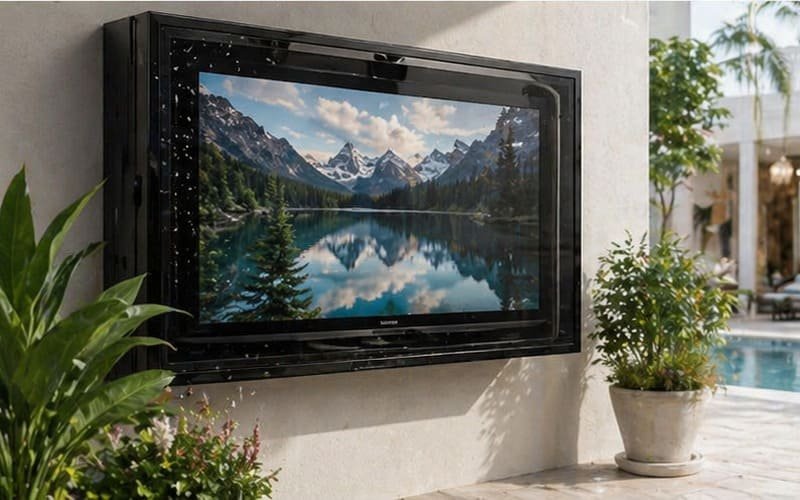
In our customer conversations, especially with sports bar owners in Texas, Arizona, Florida, and coastal resort areas, heat is one of the first concerns after weatherproofing. A TV generates its own heat, and direct sunlight adds even more. The enclosure’s job is not only to block rain. It also needs to help manage heat.
Metal has high thermal conductivity, so it transfers heat quickly. In some enclosure designs, that can help dissipate internal heat. But in direct sun, the same conductivity can also transfer exterior heat into the enclosure if the system is not properly ventilated or shaded.
Polycarbonate behaves differently. It is more insulating than metal, so the hot outer surface does not transfer heat in the same way. But that does not mean a sealed polycarbonate box can automatically protect a TV in summer heat.
Honestly, the material itself is secondary to the cooling system.
A completely sealed box, whether it is metal or polycarbonate, can trap heat around the TV. The more reliable solution is controlled airflow. Electrical enclosure thermal management resources often emphasize that electronic components generate heat during operation, and without effective thermal management, heat can accumulate and reduce performance or cause failures. Thermal management for electrical enclosures
This is why our Pro and Ultra series enclosures are designed with built-in fan systems. We’ve learned that consistent air circulation is one of the most important factors in preventing screen blackouts and overheating complaints.
For example, a smaller enclosure may only need two fans, while larger sizes need stronger airflow. But the principle is the same: the enclosure needs a planned air path, not just a protective shell.
| Heat Factor | Why It Matters | What I Check First |
|---|---|---|
| Direct sun | Adds heat to the enclosure surface and screen area | Can the TV be shaded or repositioned? |
| TV size | Larger TVs generate more heat | Does the enclosure have enough airflow? |
| Fan design | Poor airflow leaves hot spots | Are intake and exhaust paths clear? |
| Internal spacing | Tight fit blocks air movement | Is there room around the TV body? |
| Venue use hours | Bars and resorts may run TVs all day | Is the fan system suitable for long operation? |
| Color and surface exposure | Dark surfaces can become hotter in sun | Is the installation in direct sunlight? |
This is also why I do not like making a simple claim such as “metal is hotter” or “polycarbonate is cooler.” In real installations, the material, color, airflow, shade, and TV heat output all work together.
For humid climates, polycarbonate helps reduce corrosion risk. For hot climates, the cooling system becomes the key design factor.
How does the enclosure’s seal hold up in salty, humid air?
You need a truly weather-resistant seal for your coastal resort, poolside bar, outdoor restaurant, or humid patio. A failed seal means a dead TV, an unhappy guest, and an expensive replacement right in the middle of your busy season.
The weatherproof IP rating depends on the full assembly, not just the box material. In salty air, corrosion around metal seams, locks, hinges, screw holes, or gasket contact points can create uneven surfaces and tiny gaps. A polycarbonate body removes the risk of body rust, but the gasket, locks, cable exits, and hardware still need good design.
An IP65 rating means the enclosure is dust-tight and protected against water jets under defined test conditions. The International Electrotechnical Commission explains that IP ratings grade the resistance of an enclosure against the intrusion of dust or liquids. IEC IP ratings
But I always explain IP65 carefully to customers. IP65 does not mean the enclosure is vapor-proof. It does not mean it is condensation-proof. It does not mean the product can be submerged in water. And it does not mean the installation is still protected if the cable exits are left open or the gasket is not compressed correctly.
In real installations, the final protection depends on:
- Gasket compression
- Locking pressure
- Cable exit sealing
- Hinge and lock design
- Smooth gasket contact surfaces
- Installation angle
- Wall mounting quality
- Long-term maintenance
The seal is only as good as the surfaces it presses against. We often get feedback from AV installers in coastal regions who have replaced failed enclosures. They usually do not say the whole box failed at once. They talk about small weak points: rust near the frame, rust around a screw hole, coating damage near a lock, or corrosion where the gasket sits.
Once the frame surface becomes uneven, the gasket may no longer press evenly. That is all it takes for humid, salt-laden air to find a path inside.
The same risk applies to hinges and locks. On a metal box, the area where the lock is mounted can become a corrosion point if coating is damaged or hardware is not suitable for the environment. Over time, this can affect both security and sealing.
During our own quality control, we focus heavily on the precision of the channels that hold the gaskets. With polycarbonate, the body itself will not develop rust. That does not mean the entire enclosure is maintenance-free forever, but it does mean one major failure mode is removed from the body structure.
For humid and coastal B2B installations, that matters. A hotel, resort, school, or restaurant does not only care about the first installation day. They care about what happens after one summer, one rainy season, or several years of exposure.
Here is the practical way I usually explain the decision:
| Installation Condition | Metal Enclosure May Work If… | Polycarbonate Is Usually Better If… |
|---|---|---|
| Dry inland climate | Coating is high quality and maintenance is easy | Lightweight handling and impact resistance are priorities |
| Coastal bar or resort | Marine-grade coating and stainless hardware are used | Lower body-rust risk and lower maintenance are priorities |
| Poolside installation | Hardware and seams are protected from chemical exposure | Humidity and cleaning exposure are constant concerns |
| High-impact public area | Thick metal body is required for a specific security reason | Impact-resistant front shield and lockable body are enough |
| Long-term B2B installation | Regular inspection and touch-up are planned | Maintenance access is limited or costly |
| Hot sunny location | Thermal design is engineered carefully | Fan cooling, UV-stable PC, and proper shade are included |
| Humid enclosed patio | Coating damage can be inspected often | A lower-maintenance enclosure body is preferred |
FAQ
Is polycarbonate better than metal for humid climates?
In many humid or coastal environments, I usually see polycarbonate as the lower-risk choice because the enclosure body itself does not rust like steel. Metal can still work well if it uses the right coating, stainless hardware, careful sealing, and regular maintenance. The key difference is that polycarbonate removes one common failure path: body corrosion around scratches, seams, and gasket areas.
Will a metal TV enclosure always rust outdoors?
No, a metal TV enclosure will not always rust. Aluminum, stainless steel, galvanized steel, and powder-coated steel all behave differently. A well-designed metal enclosure can perform well in many outdoor locations. The risk becomes higher in coastal, poolside, or humid environments where scratches, screw holes, cut edges, locks, and hinges are exposed to moisture and salt air.
Does polycarbonate mean ordinary plastic?
No. Polycarbonate should not be confused with ordinary thin plastic. A good polycarbonate TV enclosure needs enough wall thickness, UV-stable material, an impact-resistant front shield, precise gasket channels, and proper cooling fans. The material choice matters, but the full enclosure design matters even more.
Which material is better for coastal bars, hotels, and resorts?
For coastal bars, hotels, resorts, and poolside venues, I usually recommend polycarbonate because it reduces the risk of body rust and lowers long-term maintenance pressure. These locations often face salt air, humidity, cleaning routines, long TV operating hours, and limited maintenance access. In that type of environment, lower maintenance can be more important than the initial heavy feel of metal.
Does a polycarbonate TV enclosure solve heat problems?
No material solves heat by itself. A polycarbonate body can help reduce corrosion risk, but heat control still depends on the cooling system. Fan design, airflow path, internal spacing, shade, enclosure color, and TV size all matter. A completely sealed box, whether metal or polycarbonate, can still trap heat around the TV.
Is IP65 enough for a humid outdoor TV enclosure?
IP65 is a strong protection level for many outdoor TV enclosure applications because it means the enclosure is dust-tight and protected against water jets under defined test conditions. But IP65 does not mean vapor-proof, condensation-proof, or submersible. Real protection also depends on gasket compression, cable sealing, locks, hinges, and correct installation.
When would I still choose a metal TV enclosure?
A metal TV enclosure may make sense when a project requires a very specific heavy-duty structure, when the location is dry and inland, or when the buyer has a regular maintenance plan for coating damage, hardware, and corrosion inspection. For humid coastal installations with limited maintenance access, I usually see polycarbonate as the more practical long-term choice.
Conclusion
In humid and coastal areas, I usually see polycarbonate as the lower-risk, lower-maintenance solution for outdoor TV protection. The biggest reason is simple: the enclosure body itself does not rust like steel.
That does not mean every metal enclosure is bad. A well-designed metal enclosure with the right coating, stainless hardware, good sealing, and regular maintenance can work in many environments. But in salty, humid air, the weak points are often scratches, seams, locks, hinges, screw holes, and gasket contact areas. Once corrosion starts near those points, the enclosure is no longer just losing its appearance. It may also lose sealing reliability.
Polycarbonate helps remove that body-corrosion risk. When combined with a proper gasket system, sealed cable exits, lockable design, impact-resistant front shield, and active cooling fans, it becomes a very practical choice for humid climates, coastal bars, hotels, resorts, poolside venues, and outdoor commercial installations.
The way I explain it to customers is this:
Metal can feel stronger on day one. Polycarbonate can be lower-risk after years of humidity, salt air, and daily use.
For B2B buyers, that long-term reliability often matters more than the initial feel of the enclosure.